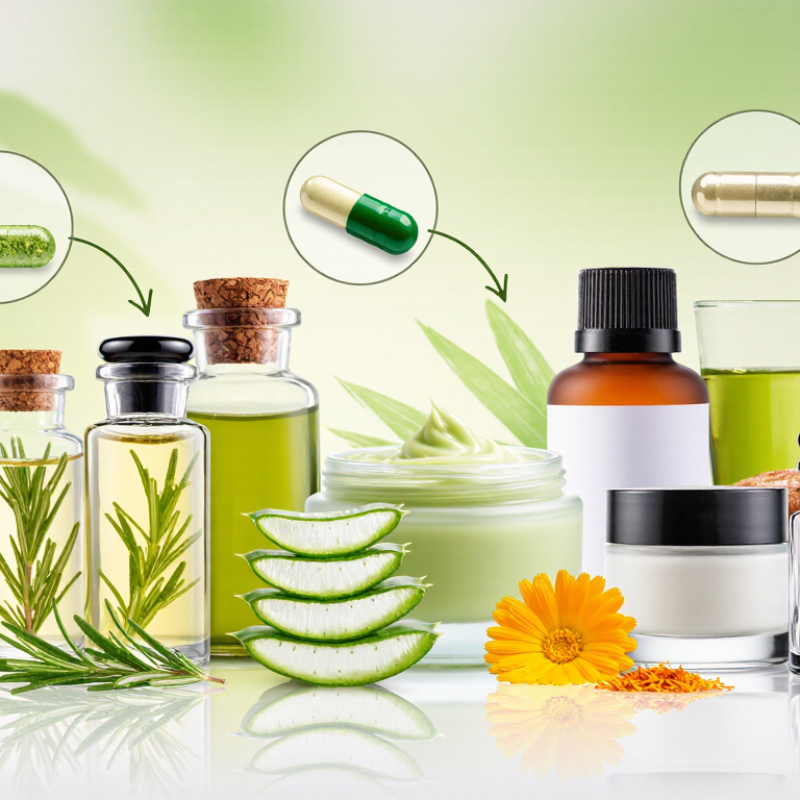
What are common uses of plant extracts? The answer reaches far beyond herbal tea. Extracts appear in foods, beverages, personal-care products, fragrances, and dietary supplements. A green-tea extract may add a recognizable botanical ingredient to a capsule; rosemary extract can help protect oils from oxidation. In skin-care products, aloe and calendula extracts are used for their sensory and formulation properties. Their effects depend on the specific plant, extraction method, concentration, and finished product.
The market is growing. Grand View Research estimated the global botanical extracts market at USD 6.8 billion in 2023 and projected a 9.2% compound annual growth rate from 2024 to 2030. That is a market estimate, not proof that every extract works as advertised. WHO’s 2019 Global Report on Traditional and Complementary Medicine found that 88% of WHO Member States reported using traditional medicine. The figure describes broad practice, not the effectiveness of every plant product.
Public-health expert Dr. Tedros Adhanom Ghebreyesus has described traditional and complementary medicine as “an important and often underestimated part of health services.” The distinction matters: traditional use can guide research, but it does not replace product-specific evidence. Quality matters. Extracts can differ in plant identity, active constituents, and strength, even when labels look similar. Readers should look for clear ingredient names, standardized amounts where relevant, and credible quality testing. And the label rarely tells the whole story. A botanical ingredient’s common use is not automatically a proven benefit, a point worth keeping in view as we examine where extracts appear and what evidence supports them.
Plant extracts begin with plant material, but the method determines which compounds enter the final liquid. Water draws out many water-soluble substances, including some sugars, tannins, and pigments. A warm infusion may resemble herbal tea; longer steeping can deepen its color and bitterness. Simple, but not neutral. Heat and time can also alter delicate constituents.
Solvent extraction uses a liquid selected to dissolve compounds with particular chemical properties. Water-ethanol mixtures, for example, can capture a broader range than water alone. The result also depends on plant part, particle size, solvent strength, and temperature. “More concentrated” does not automatically mean better. Producers need to check identity, composition, and residual solvents, since both raw materials and processing conditions can vary.
Steam distillation is mainly used to collect volatile aromatic compounds. Steam passes through leaves, flowers, or peels; the vapors cool and separate into aromatic oil and water. This method is selective, not a complete portrait of the plant. Heat-sensitive compounds may be lost or changed. Extraction records and suitable laboratory analysis can help describe an extract’s composition, though they cannot make every batch identical. That uncertainty deserves attention.
Water draws out soluble compounds, such as some sugars, tannins, and pigments. A longer, warmer steep can deepen color and bitterness. Heat may alter delicate compounds.
They can capture a wider range than water alone. The result depends on the plant part, particle size, solvent strength, and temperature. More concentrated does not always mean better.
It mainly collects volatile aromatic compounds from leaves, flowers, or peels. Cooling separates aromatic oil from water. It is selective, not a complete portrait of the plant.
Yes. Heat, time, and processing conditions can affect which compounds remain. Some heat-sensitive compounds may be lost or changed. Not every batch will match exactly.
They can keep extraction records and use suitable laboratory analysis. These steps help, but they cannot make every batch identical. Some uncertainty remains.
Some may repel insects, interfere with feeding, or affect pest growth. Their effects depend on the active ingredient and intended use. “Plant-based” alone explains little.
They should check the product label for covered crops, target pests, application rates, and protective measures. Small details matter. A missed instruction can change the risk.
Timing and coverage can matter; spray may need to reach leaf undersides. Rain and strong sunlight can affect performance. Field results are not always neat.
What are common uses of plant extracts? Their applications range from food and beverages to cosmetics, medicine, and agriculture. The way an extract is made—using water, solvents, or steam—can influence its composition and the properties it brings to a finished product. In foods and drinks, extracts may contribute flavor, color, or functional compounds. In cosmetics and fragrance, they can serve as ingredients of natural origin, a category addressed by ISO 16128-1:2016.
Plant extracts also have a role in medicinal products, including those connected with traditional medicine. The World Health Organization reports that traditional medicine is used in 170 of its 194 member states. In agriculture, certain plant-based pest-control products are classified by the U.S. Environmental Protection Agency as biopesticides. Across these fields, their uses depend on the extract’s composition and intended application.

 Debaoyi Natural Plants